Why the new national milestone target for reusable packaging is a step in the right direction but is not enough
16 July 2021
Why the new national milestone target for reusable packaging is a step in the right direction but is not enough
The transition from single-use packaging to reusable packaging is an important step towards waste reduction and a circular economy. In Sweden in 2020, a milestone target was decided towards this transition and at the same time, several business models are developing around the world and in Sweden to promote the reuse of packaging. However, as we will see in this article, the decided target has several limitations preventing an efficient and rapid transition: it is too broad and misleading, it only aims at improving an evolution and not at reaching a specific level of reusable packaging and finally, it leaves out some reuse alternatives.
:pencil: Written by Jeremy Meteyer & Chloé Johnsson
The milestone target and the definition of reusable packaging
The new milestone target is defined as such: Of the packaging that is placed on the market in Sweden for the first time, the proportion that is reusable must increase by at least 20 percent from 2022 to 2026 and by at least 30 percent from 2022 to 2030. It is worth mentioning that the proportion of reusable packaging to be increased is here expressed in weight.
This milestone target for reusable packaging relies on concepts and definitions specified in EU directives and Swedish legislation, mainly the EU packaging directive. A packaging is thus defined as a product that has been manufactured to contain, protect or present a product from raw material to final product and from producer to consumer. Also, reuse means that something that is not waste is used again to fulfill the same function for which it was originally intended.
Therefore, Naturvårdsverket defines reusable packaging as such: a packaging that has been designed, constructed and placed on the market to be reused several times during its life cycle by being refilled or reused for the same purpose for which it was designed (2).
This definition excludes therefore two types of products that we consumers might consider as reusable packaging. It is the case for products such as thermos mugs and food boxes designed for repeated use that are sold without content, as well as packaging such as glass jam jars and plastic ice cream pots that are designed for single-use and might be reused by the consumer. These products are not considered as reusable packaging by the Swedish legislation as they are hard to track and quantify.
The four reuse models
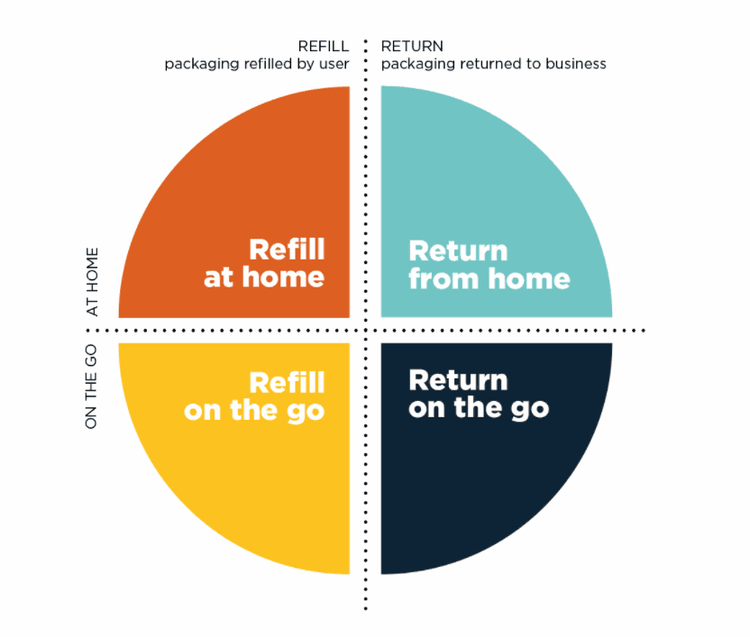
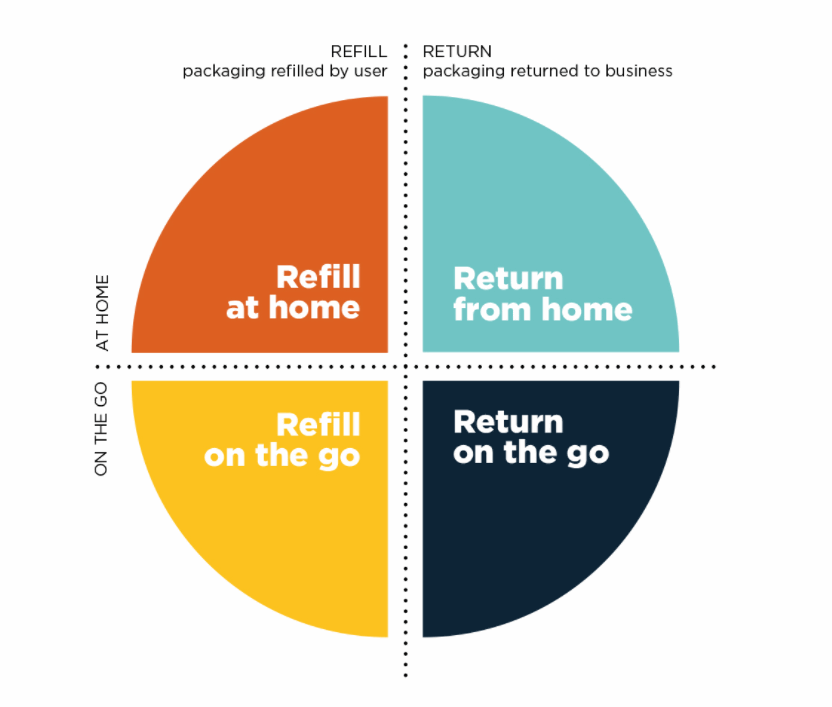
In its report Reuse - Rethinking Packaging (3), the Ellen MacArthur Foundation states that business-to-business reuse models are already better understood and adapted at scale, therefore focusing on business-to-consumer reuse models is a priority. Based on existing examples of business models, the Foundation has identified four different types of business-to-consumer reuse models, and the four of them can be illustrated with local examples already existing in Sweden.
Refill at home
In this model, users refill their reusable container at home. It is particularly well-suited for e-commerce selling for example refills delivered through a subscription service.
A Swedish example of this model is the startup Lifelong, providing personal care products that reduce the need for single-use packaging. The users are provided with reusable packaging for hand wash, body wash and shampoo. The personal care products are delivered by the postal service in the form of powders that the users mix at home with tap water to create the final product. In this way, the need for packaging is limited as the powder is a fraction of the volume of the final product and furthermore the packaging is compostable with the bio-waste collection system.
Refill on the go
In this model, users refill their reusable container away from home. It requires a physical store or dispensing point and is therefore well-suited for traditional retail outlets and urban environments.
A Swedish example of this model is Stockholm’s first physical packaging-free shop Hushållet, selling products in bulk. There, customers bring their own bags, boxes and jars which allows them to buy the desired quantity and pay per weight.
Return from home
In this model, users get products at home and the packaging is picked up from home by a pick-up service, for example by a logistics company. It is well-suited for e-commerce, urban areas and a large range of product types.
A Swedish example of this model is Unwrapped, selling pantry items online. The users order items online and can choose between different quantities. The products are delivered in reusable bags and boxes that are picked up at the next delivery. The company then cleans the bags and boxes and uses them again for the next orders and deliveries.
Return on the go
In this model, users return the packaging at a store or drop-off point, for example in a deposit return machine or mailbox. It is suitable for many different applications, from traditional retail outlets to take-away consumption.
A Swedish example of this model is Loop-it, enabling a deposit system for reusable cups. The users buy a take-away coffee, consume it and return the cup in any coffee shop affiliated to the network. The coffee shop then cleans the cup and reuses it for the next order.
Limits of the new milestone target and recommendations
The milestone target and the definition of reusable packaging are somehow abstract and misleading for several reasons:
The target is too broad
The target does not differentiate between households and businesses, that is to say that reuse in households and reuse in industries are quantified together. This is problematic as reuse in industries is somewhat already developed while reuse in households is not. With such a broad target, it is enough that industries start using more reusable and heavy packaging for the target to be reached without any changes in the households. Therefore, two separate targets, one for households and one for industries, would make more sense and would drive development forward in both branches.
The target in weight is misleading
The proportion of reusable packaging placed on the market to be increased by 20% and 30% is expressed in weight. This is problematic as different items have different weights: a reusable cup cannot thus be compared nor quantified together with a reusable wooden pallet. With such a broad and misleading target, it will thus be enough to develop the reuse of certain heavy items in one sector only for the target to be reached. Therefore, in order to avoid putting all the reusable packaging in the same category, it would make more sense to adopt several sector-specific targets.
The target is an “evolution target”
The first official statistics of the proportion of reusable packaging will be available and will quantify the change from 2021. Before that in 2020, Naturvårdverket estimated that 14% of the total amount of packaging is reusable, acknowledging that this estimation is very uncertain (4). The new milestone target prescribes an increase of reusable packaging placed on the market by at least 20 percent from 2022 to 2026 and by at least 30 percent from 2022 to 2030. In other words, an increase by 20% and 30% of this ratio would raise it to 16.8% and 18.2% respectively, that is to say not a significant difference. With such a target, the increase of reusable packaging will not be significant as the reference data (14%) is already quite low. Therefore, it would make more sense to adopt real targets directly targeting a level of reusable packaging to reach.
Refill alternatives are excluded from the target
The target does not clearly link to any requirement of rotation systems, but at the same time, it meets the obligation for European countries to report the quantities of reusable packaging put on the market every year (European packaging and packaging waste Directive, 2019/665). In order to be reported and quantified, a packaging needs to be within a system where it will rotate several times. Packaging circulating in business models relying on return alternatives, that is to say where they are returned to the business (return from home and return on the go), are easy to quantify and report. But that is not the case for packaging used within refill alternatives (refill at home and refill on the go), as they are the property of users and therefore not included in a rotation system. As these packaging are hard to track, they are therefore not included in the definitions of reusable packaging nor in the national target.
Refill alternatives play an important role in reducing single-use packaging and promoting reuse och Zero Waste Europe estimated that packaging-free shops have avoided on average 1 tonne of packaging per year and per shop (5). Business models relying on refill alternatives are well-developed in other parts of Europe, and while France counts about 620 packaging-free shops (6) on its territory, Sweden counts about ten at the present time! Therefore it is necessary to implement diverse types of policies and targets aiming at both return and refill alternatives, and even include constraints to make the transition happen. Sweden can learn from what is being done abroad: in France for example, there is a draft law obliging supermarkets bigger than 400m2 to allocate 20% of its area to bulk sales (7). In this way, refill alternatives would be available for most consumers which will ease the transition towards a society with less waste.
Sources
(1) Sveriges Miljömål, Återanvändning av förpackningar
(2) Sveriges Miljömål, Återanvändning av förpackningar
(3) [Ellen MacArthur Foundation (2019)](Reuse - Rethinking Packaging https://www.ellenmacarthurfoundation.org/publications/reuse)
(4) Naturvårdsverket (2020), Skrivelse: Etappmål för förebyggande av avfall
(5) Zero Waste Europe (2020), Packaging Free Shops in Europe – An initial report
(6) Réseau Vrac, "Épiceries Vrac en France et dans le monde"
(7) Ministère de la Transition Écologique (2021), Presentation of the bill to the Council of Ministers